ANDRÉ HELLER PARK IN VIENNA
A Space Between Everyday Use and Artistic Design
On one of the first truly sunny afternoons of early spring, the park along the Old Danube already feels lively and well used. Despite it being an ordinary weekday, people fill the space naturally and without overcrowding it — an early indication that the park has already found its place in everyday life. At the same time, it raises the question of what exactly sets this place apart from Vienna’s many other green spaces.

Vienna Mountain von Ugo Rondinone
How does the park function in everyday life?
I deliberately waited for good weather before visiting the park. After weeks of grey winter days, this sunny afternoon at the end of February offered one of the first real opportunities to experience the space under realistic conditions. It quickly became clear that many others had the same idea.
Even on a weekday afternoon, the park is noticeably active. People sit on benches, walk along the paths, or use the area for exercise. None of this feels staged or forced — the space is simply being used in a natural way. For residents living nearby, this is clearly a major advantage. The location along the Old Danube strengthens this atmosphere even further: the combination of water and open green space creates an environment that feels calm while still remaining alive and social.
The park itself is clearly organized. Right at the entrance, an information board explains the layout and structure of the area, making the space immediately easy to navigate. Overall, the park leaves the impression of being carefully planned and internally coherent.

Entrance with overview board
Its facilities also show an attempt to accommodate different kinds of use. Alongside seating areas and walking paths, there are playgrounds for children and freely accessible outdoor fitness equipment. These training areas stand out positively, especially because this kind of public exercise infrastructure is still not equally common throughout Vienna. The park also includes basic but important infrastructure such as public toilets — something that becomes essential in heavily used public spaces.
Walking through the park, it becomes obvious that the spatial organization works well. Different groups use the area simultaneously without disturbing one another. Instead of overlapping or competing uses, there is a certain ease in how people move through and occupy the space — a quality that cannot simply be designed on paper, but only becomes visible in actual daily use.
At the same time, some aspects still feel open. A small café or bakery, for example, could further enhance the experience and extend the amount of time people spend there.
Accessibility also contributes to the park’s overall functionality. For nearby residents, the area is directly reachable on foot, while visitors from other districts can reach it from Floridsdorf station via a short bus ride of around ten minutes.
Who is behind the park — and what role does André Heller play?
The park’s name is closely connected to its artistic concept. The overall design was developed under the direction of André Heller, the Vienna-born artist, writer, and cultural figure who has worked internationally for decades. His projects move between theatre, music, literature, and large-scale spatial and landscape installations.
Heller is particularly known for creating immersive environments in which nature, art, and atmosphere interact with one another. In these projects, the focus is usually not on individual objects, but on the experience of the space as a whole. This approach is clearly visible throughout the park at the Old Danube.
At the same time, the project is not the work of a single individual alone. The park was realized by the City of Vienna in cooperation with UniCredit Bank Austria, which supported the project and gave the park its official name.
What distinguishes this park from other parks in Vienna?
What most clearly separates the park from many other green spaces in Vienna is the consistent integration of art. Here, art does not function as decoration added afterwards, but as a central part of the overall concept.
Across the park, 14 artistic works by international artists are distributed throughout the landscape. These include not only traditional sculptures, but also sound objects, wind-driven installations, and other designed interventions that shape how the space is experienced. The following focuses on some of these works.
As the park carries André Heller’s name, it is fitting that he is represented through one of the central works in the area. His sculpture The Water Guardian stands directly along the shore of the Old Danube. The approximately four-metre-high figure holds a wind wheel over five metres tall, while water and lighting effects make the installation visible both from the park itself and from the water.

The Water Guardian by André Heller
At the entrance, Monika GilSing’s Entrance to the Treasures creates a clear opening moment. The colorful figures function almost like a visual threshold, immediately introducing the park’s curated atmosphere.

Entrance to the Treasures by Monika GilSing
Further inside the park, Vienna Mountain by Ugo Rondinone becomes one of the most visually striking works. Its stacked, brightly colored forms create a strong contrast with the surrounding landscape while still integrating naturally into the park’s pathways and open spaces.
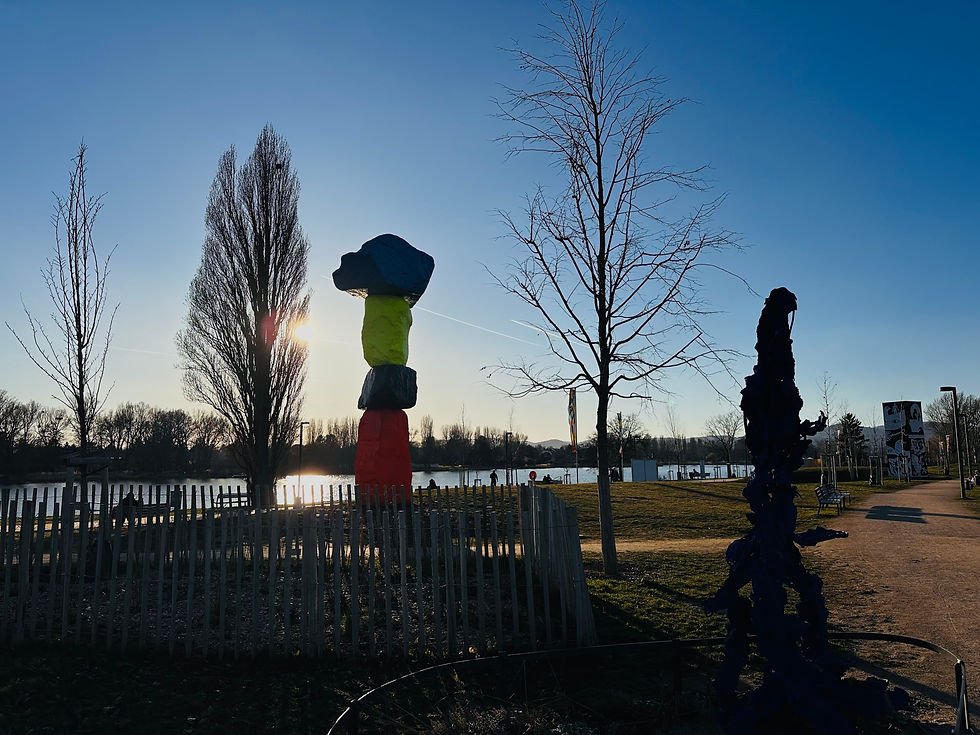
Vienna Mountain by Ugo Rondinone
A very different approach appears in Xenia Hausner’s Atemluft. The oversized sculptural head combined with a gas cylinder feels both direct and unsettling, introducing a more conceptual and psychological dimension into the environment.

Atemluft by Xenia Hausner
Movement plays a central role in Era Tsao’s The Shape of the Wind. Its metallic elements react continuously to air currents, turning the work into something constantly changing rather than static.

The Shape of the Wind by Era Tsao
Elmgreen & Dragset’s The Guardian also alters the perception of the surrounding space. The oversized seated figure placed high above eye level redirects attention not only toward itself, but toward the landscape around it.

The Guardian by Elmgreen & Dragset
These works are accompanied by additional elements along the pathways, including kinetic and acoustic objects that often reveal themselves only while moving through the space.
What connects the artworks is not monumentality, but their integration into the landscape. They do not demand constant attention; instead, they gradually unfold through movement, changing perspectives, light, wind, and distance. The park therefore feels less like a traditional sculpture exhibition and more like a space in which art becomes part of everyday presence.
Rather than relying on spectacle alone, André Heller Park succeeds through the interaction between atmosphere, accessibility, and artistic intervention. Its strongest quality may be that the space already feels naturally inhabited — not simply designed to be observed, but to be used, crossed, and experienced over time.
Sources
UniCredit Bank Austria: Bank Austria Park – Project descriptionhttps://www.bankaustria.at/bank-austria-park.jsp
City of Vienna / Project page: Bank Austria Park at the Old Danubehttps://wienwirdwow.at/bankaustriapark/
Photos
Katalin Toth


